Inspirational Places

What does travel do?

It doesn’t just make you skint, doesn’t just make you have to book valuable days off work and it doesn’t just leave you jetlagged & sunburnt.

It opens doors for new experiences that carve out memories you’d never think you’d have.

There’s a world outside your comfort zone and, as a creative, you should take the chances (as and when they come) to broaden your horizons.

tram

When I was younger I didn’t believe in holidays, although I think that was mostly just because I couldn’t afford them.

My reasoning was that it was a waste of money and what was the point in paying for memories? After all you can’t do anything with memories, what’s the point in paying for an experience that will be over soon? Why not just splash the money on material things?

How wrong I was. Sometimes you meet people and you unlock life hacks and secrets that change your thinking for the better.

But that’s the thing…the things you think you know when you’re younger, aren’t always as true as they seem when you look back at them with fresh, older eyes.

So if you feel a bit stuck, as if you can’t find inspiration anywhere you should step outside your door and find a plane going somewhere you like the sound of.

The featured image is of the city of Budapest. A place full of beauty, adventure and dangerously good wine.

The Pursuit of Happyness

Have you seen the film ‘The Pursuit of Happyness‘?

If you haven’t, I highly recommend it. Will Smith stars as struggling salesman, who’s trying to make ends meet for his wife and young son.

Luck doesn’t go his way, and he falls into a downward spiral – which hits a climax when he winds up homeless.

Things get so bad that he ends up sleeping in a public toilet cubicle one night. His young son lying beside him.

But, rather than feel sorry for himself (I wouldn’t blame him if he was), he looks for opportunity and clinches an internship as a broker in the city. It’s not a paid gig sadly, and it’s so competitive that only one person will end up with a full-time role.

What I like about Will Smith’s character in the film is that he continually visualises success. He knows that, given the right moment and chance, he can do it. It’s his belief that wins the audience over, and ultimately wins his employers over.

And I ask you, as an aspiring creative…how often do you visualise the success you want?

Whether you want to be the next Stephen King, the next Picasso or just a cool designer who has an office that overlooks a city skyline.

Whatever you’re doing right now, take a moment to visualise the success you want. I know it sounds cheesy, but if you don’t know what your destination looks like…how can you get there? How can you know that you’re making progress if your path is murky and blurred?

I once heard about a guy who visualises success so much that when he’s driving he pretends that he’s being interviewed about his novels and speaks about them as if he’s talking to an interviewer.

Ahem…I promise you that guy isn’t me…

by Ashley Brown 2017


A King in a dress

I was listening to a podcast today and amongst all the great content included, there was one snippet of a story that stuck with me.

It was about a pre-teen boy who was, for whatever reason, wearing a dress. Someone else in his class stopped him and said:

“You can’t wear that. You’re not a princess”.

His reply?

“I can. I’m a King in a dress”.

If that’s not a perfect example of using creativity to change someone’s perspective, I don’t know what else is.

And, as writers, many of us have messages to deliver, as well as stories. Whether they be social, ethical or everything in-between.

Your creativity is a great tool, and it empowers you – giving you the ability to present things in a way that others can understand and empathise with. Use it wisely.

If you’re interested the podcast was ‘Guilty Feminist’ – which I highly recommend.

Did you hear the one about the internet and the spade?

The internet. It seems like such an all-powerful thing doesn’t it? A 24/7 access to everything around us, available at the touch of a fingertip.

A way to socialise, to work, to sell and to find information. A digital land of happiness, cat memes and dark, evil corners.

When I think of the internet, the first image that comes to mind is a giant cyber brain. That’s constantly pulsating and growing. Growing bigger and bigger by the day.

It’s a complicated thing. Few of us really understand it, and even though we take it as part of our day-to-day it’s still an awe-inspiring thing.

Let me take you now to the Georgian capital city of Tbilisi. A place of cobblestones and art Noveau buildings, among many other things.

One day, not so long ago, a 75 year old woman was out digging for scrap metal. She was just on the outskirts of the city and had been working really hard that day – the more scrap she got, the more money she’d head home with.

tibilisi

As she was digging her spade accidentally ripped through a cable. Naturally this worried her, but after a quick look around all seemed okay and there was no one around to notice. So she continued her day’s work, set the memory of the cable aside and as dusk fell across the city she headed home.

Meanwhile, web-users in neighbouring Armenia were having a tough day. No matter how hard they tried they just couldn’t get online. It took five hours for them to realise that something had gone wrong in Georgia, the country that provided 95% of their internet.

You’ve probably guessed what happened.

The cable that the old lady had damaged was a fibre-optic one that provided Armenia with their internet.

Sure they fixed it soon enough, once they’d realised.

But, it just goes to show that even though the cyber world around us is so advanced and complex, it isn’t invincible.

Something as simple as the spade can conquer the internet.

It’s the same with life. As intense and complicated as it may well be, we need to make time for the simple things and look out for the simple problems – as they could very soon evolve into much bigger problems.

Hamburg, the Beatles and the sweet music of success…

As regular readers will know, I’m a big believer in the theory that it takes 10, 000 hours of practice to be good at something.

But, while practice makes perfect, there are other factors that can control success and give some of us an exceptional advantage over others in our field. While I don’t claim to be successful just yet, any talent I have when it comes to writing stems back to the hours of practice I put in as a youth.

My parents’ house was so far out of town I had little else to do on some evenings but write and be creative.

But, let’s use a more interesting case study…’The Beatles’. If you haven’t heard of them…then…where have you been? They defined popular music and elevated it to the dizziest contemporary heights imaginable.

Many people still wonder, even now, what it was that made them so good. I believe that part of it was due to some gigs they played in a German city…

An unlikely twist of fate took them to the city of Hamburg when they were very young…and it was that same twist of fate that helped give them something of an edge over the other bands and solo artists of the day.

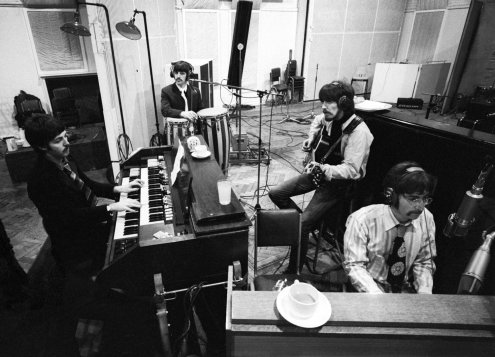
beatles

Back in the day, as a small band of high school kids, The Beatles were lucky enough to get an invite to play in Germany. And, they took it – one of the reasons being that they had access to a lot of alcohol and sex over there. The other reason (more relevant to this post) is the access that it gave them to clubs who wanted them to play live music to big crowds.

When it came to gigging, the Hamburg clubs differed to the English ones in a key way. Back in Blighty the guys were asked to play a set for an hour, or maybe two if they were lucky.

But, in Hamburg, the club promoters wanted them to play all night – meaning that they’d often be going for 6-8 hours!

Imagine that…gigging for eight hours! I can only imagine the sweat.

Not only that, but as the guys’ popularity skyrocketed in Germany, the Hamburg clubs wanted them to play every night of the week. Some fifty-six hours of performing. In total, after several trips, they played for 270 nights in just over a year and a half.

This meant that the guys had to improve their stamina, their stage presence and, above all, they had to learn more songs.

They couldn’t get by with just playing their go-to ‘hits’ they had to learn loads of new songs and even different genres – such as a few jazz numbers. This gave them a discipline on stage that other bands at the time just didn’t learn – plus, it gave them plenty of time to practice until they made it perfect.

As John Lennon said; “in Liverpool we’d only ever done one-hour sessions, and we just used to do our best numbers, the same ones, at every one. In Hamburg, we had to play for eight hours, so we really had to find a new way of playing”.

So, as someone who wants to make it as a creative – you need to look out for your Hamburg. Something special that gives you an edge or an experience over the others. Whether it be using weird dreams you had as a kid to influence your art, or maybe booking a month off work and going to your grandparents’ quiet holiday house on the coast to write uninterrupted.

The research for this post mostly came from Malcolm Gladwell’s fantastic book ‘Outliers‘, I thoroughly recommend it to anyone interested in success and talent.

by Ashley Brown 2017


The Way of the Dog

dog

This is one of the best photos I’ve seen in a long time and I think we can learn a lot from it.

As the story goes, a massive parade was being held in Mexico for the Pope and, by some twist of fate, a dog ended up walking down the pathway that had been set up.

What did the dog do? Did it get all embarrassed? Did it run off to the nearest corner? Did it post a status beginning with the words ‘that awkward moment when…’ ?

Nope. It did none of the above. In fact, some say that the dog actually thought the parade was in its honour – it didn’t think to doubt itself for a minute.

Why wouldn’t those humanoids hold a celebration for me? I’ve been a good dog!”

It just enjoyed the moment. Dogs are good at that. Humans aren’t. We’re all so conditioned to over-analyse and worry about things that we’re guilty of not enjoying ourselves as much as we could.

People tend to like dogs because they’re honest, loving and fun.

Maybe we could consciously be more like them sometimes.

I’ll leave you with the words of Dale Carnegie, author of ‘How to win friends and influence people”…

“Actions speak louder than words, and a smile says, “I like you, You make me happy. I am glad to see you.” That is why dogs make such a hit. They are so glad to see us that they almost jump out of their skins. So, naturally, we are glad to see them.”

3 lessons you can learn from my first car…

After being together for eleven years I’m now in the process of selling my first car.

As much as I’d like to have kept it forever and ever, life has a way of moving on. But, as I’ll mention later, that doesn’t mean you can’t keep the memories.

There was a badge on my first car that bore the legend ‘Independence’. Which is beautifully apt, as that’s what it gave me – a full sense of independence that I’d never had before. I could go anywhere that the roads could take me.

20170603_183448.jpg

My first car wasn’t the best model out there, it wasn’t the fastest and it certainly wasn’t the biggest. But yet it was with me through many adventures, and I learnt a lot from it.

Here are 3 lessons that you can learn from my first car…

Don’t be afraid to take the reins…

My first car didn’t have power steering. To get that car to swerve in any direction it took a lot of wrenching…and parallel parking was always a problem.

(For those not in the know power steering basically makes it easier to steer your car. It’s like having an extra hand on your wheel – helping you ease off into the direction of your choice.)

But I learnt that sometimes you need to use a bit of brute force, sometimes you need to take problems and scenarios in life by the reins and give them a metaphorical wrench to get things going in the right direction. Sometimes we look over our shoulders too much for assistance, and it’s not going to always be there.

Practicality can trump aesthetics

Another friend passed his test around the same time as me, and we both got our cars on the road at around the same time.

He was luckily enough to be given a car that was all bells and whistles. It had been top of the range just a couple of years ago and it even had a soft top…which made him look cool as hell as he cruised through the British summer of that year with his aviators on. My car was more than a couple of years old, much older and a lot more humble.

I went miles in my car – it got me from A to B with no fuss and no frills. I ran into my friend about a year later, and he’d downsized to a car a little like mine.

20170614_200440.jpg

While his car looked awesome it wasn’t well made. There were constant problems, and parts for that car were expensive. It had cost him a couple of grand, and they’d lost a lot of money on it when they sold it. Whereas I’d spent £30 on a new wheel and £2 on an air freshener that was meant to smell like pineapple.

The glossy pages won’t tell you this, but sometimes you need to prioritise practicality over aesthetics.

Become emotionally attached to it

I fear that we underestimate nostalgia and sentimentality sometimes. No matter how long you have it for, you’ll always remember your first car. So think about it as a friend, rather than just a tool to get from A to B.

As you’ll probably know, whenever you talk to older people they’ll regale you with stories from their past. Sometimes the same story over and over again.

I used to get bored, but now I don’t…because I’ve figured out that the reason people retell stories is because they like telling them.

Who am I to rob someone of that pleasure?

Life is all about making memories. So make the most of sentimentality and nostalgia, attach mental value to things…who knows how many times you’ll revisit, retell and re-enjoy the past.

And, of course – always drive safe and take care of yourself. The most important asset you have to the world is you.

Ashley Brown, 2017

Bruce Lee on practice 

I fear not the man who has practiced 10,000 kicks once, but I fear the man who has practiced one kick 10,000 times.” – Bruce Lee.

I didn’t write today because I spent ages chasing down this Bruce Lee quote to share. I’d heard it years ago and couldn’t remember how it went.

As regular readers will know I genuinely believe that practice makes perfect.

Particularly the right quite of practice.

Sometimes you really have to narrow your practicing down to truly excel at something.