6 tips on how to write good English from the bloke who did ‘1984’…

You can write, right? You can construct a sentence, hold your audience and get your point across? Or at least you like to think so? Even the best of us can improve though, you should take a look at this…

As you may have seen, the novel ‘1984’ has had something of a second birth recently – due to a mixture of the current political climate and the simple fact that true classics never die. Like fashion, classic books tend to be reinvented by shifts in culture.

It’s been sitting in bestseller lists since it was first published in 1949. I vividly remember the first time I read it, some thirteen years ago.

I’m not sure if you were aware, but Orwell actually came up with a few succinct rules that anyone who wants to write English (well) should follow. I thought I’d share them with you on this Tuesday Evening, and I’ll add my own two bits underneath each one.

– Never use a metaphor, simile or other figure of speech which you are used to seeing in print.

Be original and don’t sound like every other soul out there. This is especially relevant now, as with the internet everyone has a voice and a platform to broadcast it from. Any two-bit writer (ahem) can start up their own blog with a silly name and starting typing! To stand out, the majority of your words need to be cliche free.

– Never use a long word where a short one will do.

Long words may go down well with an academic audience, but not every audience member is going to have a MENSA membership. Big words tend to break sentences up and if a reader snags too much while looking at your piece their minds and their eyes will soon wander…and you don’t want them to go off and buy ‘The Sun’, do you?

– If it is possible to cut a word out, always cut it out.

Less is more. With every sentence you write you’re fighting to keep your reader, so don’t drone. Be your own editor too – look everything over, and don’t be afraid to cut bland words out. You’ll also be surprised at how many typos you make when you look back at what you’ve done.

This isn’t your ‘6000 word’ University essay – you don’t need to ‘pad it out’.
(Ignore this if you’re still a student – pad away!)

– Never use a passive where you can use the active.

Active makes for exciting writing. Who gets off on reading boring stuff?
Active: The dog bit the man.
Passive: The man was bitten by the dog.
See this example here? Admittedly it’s not the longest sentence either way, but the former grabs you right away – it’s snappy (pun!) and to the point, and you’re instantly waiting for the next sentence. Whereas the latter feels a bit slow, and you have to almost compute it before you read the next sentence.

– Never use a foreign phrase, a scientific word or a jargon word if you can think of an everyday English equivalent.

Goes hand in hand with your audience – by all means use exciting words and turns of phrase – but if everyone was well-versed in jargon they wouldn’t call it jargon. Think of the internal frame of the business you work for – would your average joe (or reader) know all of your office slang and corporate terms?

Err…wot’s ROI?

– Break any of those rules sooner than say anything barbarous.

I Googled what barbarous meant. It means brutal. I guessed that because it sounded like ‘barbarian’ and barbarians aren’t known for being gentle, especially Conan.

Come on – you were wondering why I had a pic of Arnie instead of Orwell, right?

If you’re interested in Orwell’s essay, ‘Politics and the English Language’ check it out here.

A dinner party for strangers…

You’ve been asked to help your friend host a dinner party. You’re a decent cook and you know your way around a wine-food pairing scale, so you should have no problems.

The catch is…you don’t know any of the guests – they’re all your friend’s friends. Of course that’ll create a few general social hurdles for you to scale when the night comes, such as initiating conversation with strangers (!!) – but, the main obstacle is having to cook and prepare a night of entertainment for some people you know nothing about.

So what do you do? I mean, yeah you can create an all-rounder menu that you hope everyone will like – but then, particularly in this day & age, diets are so widespread that you could majorly miss the mark. And hell hath no embarrassment as embarrassingly embarrassing as mild social embarrassment, right?

Imagine the social ramifications – a collection of eyeballs bulging out as you dare to serve brie to a vegan! Or, on a somewhat darker note, the chance that the cake you prepared might trigger off a nut allergy – meaning a change of location from your living room to A & E.

And, believe me, the options in A & E vending machines aren’t gourmet. Even if you put a cocktail stick through them.

How would you resolve this predicament? It’s simple really. You’d investigate. You’d ask your friend and perhaps use social media to check their friends’ Instagrams – as, let’s face it, if a meal is munched without being uploaded to Instagram, was it even consumed at all?

But the point I’m driving at is that you’d research. You’d get an idea of who you were cooking for, and you’d make up your night accordingly. Creating a menu to accommodate everyone – a peppering of personal flair here and there.

My question is – why wouldn’t you do that for your writing?

Whether it be a blog post, a sales letter, social content, a novel, etc – you need to have an idea of who you’re writing for and what they’d like.

Next time you sit down to write something, take a little time to do some research about the kind of person you’ll be writing for.

Those reading a ‘young adult’ novel aren’t going to want to read a breakaway chapter about Thatcher’s Britain, while senior citizens aren’t going to respond very well to a meme about how annoying it is when your mum disturbs your FIFA game by calling you to dinner.

Personalisation is the key to connecting with your audience, and if you’re not interested in finding out about them you’ll struggle to engage them.

Minimalism and the never-ending ‘how are you?’

So, you’ve got a day to yourself and you’ve got a little bit of money in your back pocket. You decide to go shopping and pick up some new clothes, because let’s face it – even the best stocked wardrobe needs to be freshened up every now and then.

You walk into one of those kind of sleek clothes shops that have more mannequins than clothing lines – you know the type I mean, right? The sort of uber-white, brightly lit joint that’s so minimally minimalist you almost think you’ve accidentally walked into an empty lot.

As you enter a sales assistant walks past you – stopping briefly to assess you. They work out your social stature, your waist size and whether or not you fit in with their pre-programmed ideals of what looks best for the brand.

“Hi, how are you?” they sing out cheerfully, a couple of coat-hangers strung over each shoulder – the attached garments billowing out in their wake like a cape. A superhero for the well dressed minimalist capitalist consumer.

So, what do you say? I mean you’re not going to open up your deepest, darkest fears to a stranger are you? Well, you might. But most likely you’ll just say “I’m good” and then go about your day…staying perhaps a couple more minutes before you decide that a white t-shirt with a full stop in the middle isn’t going to make you look as cool as the person you want to be.

But do you know what I always say?

I always say, “I’m good thank you, how are you?”

And do you know what they say? Nothing. They’ve already walked past and gone back to their day – forever leaving me hanging.

Not just clothing shops, but all sorts of stores, restaurants and even bars. I’m always left wondering how they are and how their day is going.

Why do I ask? Why do I care?

Because I feel that, as a writer, I need to be in tune with other people…I need to be interested in other people.

Because that’s where the true stories lie – the beauty of observation is that it’s so easy! There are great characters all around us, with great perspectives and feelings – but if we don’t take any notice of them, we’re losing free research. A free chance to craft and calculate new characters.

It’s a well-known fact that many authors base characters on people they’ve known – because the best characters tend to originally be born of flesh and blood – not from the factories of the creative mind. Or, at least not fully.

So, open your eyes/ears and ask someone how they are.

Unless you can get Beyonce to sing halfway through your story…

In yesterday’s post I touched on the subject of sport, and I kept on thinking about it afterwards.

If the statistics that a quick Google search have given me are to be believed…and, let’s face it, in this world of ‘alternative facts’ you never know…association football is the most popular sport in the world. With a whopping 3.5 billion fans spread across the globe!

I’m happy to admit that I’m in that number. 

One of the things that I’ve noticed about football, which sets it apart from many other sports, is that it’s a fast-paced, free-flowing game. Asides from a fifteen minute break between halves the action is nearly continuous – only ever broken up by the occasional free-kick, throw-in or injury.

That makes it fairly easy to watch and it means that, unless it’s an incredibly boring game, it’s harder for the average viewer to get distracted. I’ve tried to watch sports such as cricket or American football before and I’ve never found myself as involved. The pace of cricket can be slow and a match can often last a very, very long time – I’m stumped as to why anyone can actually like it! When it comes to American football, my lasting impression is that a game seems to have more stoppages than national rail!

I find that this is something that I can attribute to my writing. I won’t lie to you, as an up and coming writer I’m looking to write for a wide target audience right now and will continue to do so until I make my name.

Any marketer worth their salt will tell you that the average Joe (or Jane) has a short attention span, so when they’re reading a story the action and the dialogue needs to have a zip and a zing to it or else their readership will soon decide to put the book down and go back to their busy lives…or at least update their Facebook statuses and find the right Instagram filter for their next meal.

So, the lesson for you and I today, is to find a flow to the action of the story and once we find it – we need to make sure that we keep it going. We should only break for long, drawn-out paragraphs of self introspection when we really have to.

Although having said that, if anyone can make their novel like the Superbowl and have Beyonce singing halfway through, that will probably work too…so don’t fully rule other sports out!

Congrats to anyone who can correctly recognise the guy in this blog’s featured image.

Centre Circles & Corner Kicks

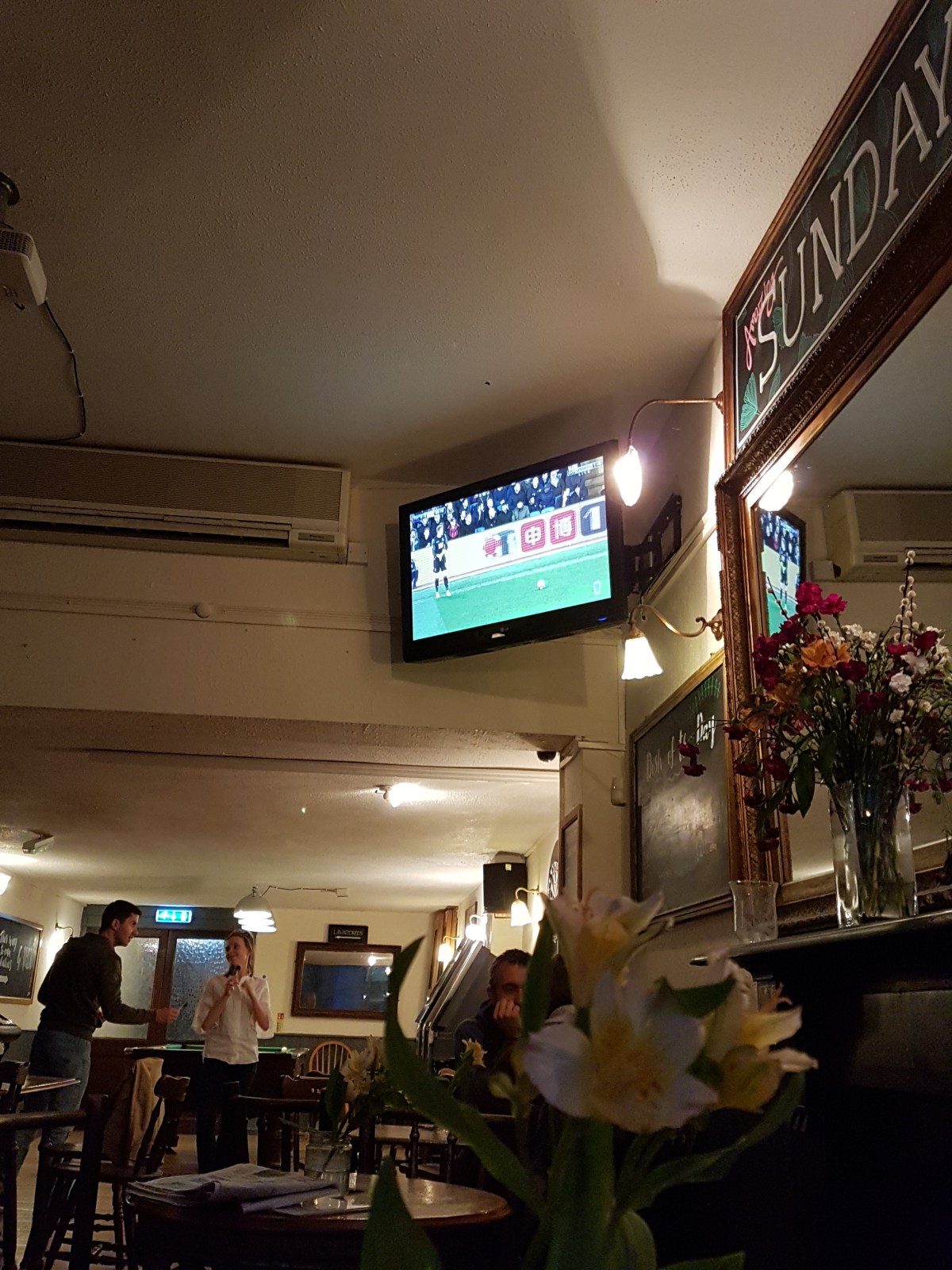
I didn’t write this evening because I watched the football.

Creatives aren’t just the artists and the writers of this fair lonely planet. They can be in all walks of life from engineers to footballers.

Ever since the days of gladiators and colloseums sport has always united and divided us.

Long may it continue. 

I’ll write tomorrow. Tomorrow is the day where I’ll begin walking down the path to becoming the greatest writer who ever lived..

The Top Shelf of the Library

I didn’t write today, because I couldn’t find the right story to start on.

I always feel that the fictional storyteller’s mind is a library of ideas and plots, many of these are easy to access and get a hold of. But, usually the ideas that you really want to pursue and start to write about are the hardest ones to find.

By that I mean, to again use the library analogy, they’ll often be on the top shelf. You can see them from a distance, and can make out a bit about them, but you need to get closer to them.  So, you’ll spend ages looking around for a ladder or maybe you’ll clumsily try and climb up the shelves until you reach the top.

Then, after using all that time to try and get a proper hold of the idea, you’ll be so distracted that all the time that you’d made to write will have floated away.

I’ve always been an ideas guy. Even as a kid I’d be more interested in sketching out my own comics and stories than I would reading them. I guess there are two types of people – those who walk out of a cinema and think; “man, that was a great film!” – and those who walk out of a cinema and think; “that was an awesome film, but I reckon I could do better”.

Creative consumers and creative do-ers.

I’ve always been the latter.

I can’t remember the last time a day went by where I didn’t have a story in the back of mind that I wanted to tell. Whether it be simple, or more complex. Sadly, without a computer (or at the very least) a notepad permanently taped to my hands the creative flow can’t always be tapped at the best time. Life has a habit of getting in the way, doesn’t it?

I wonder how often, in the whole history of the world and everything ever, truly great masterpieces have fallen to the wayside because the potential authors just weren’t able to organise their mental libraries in time to grab the bull by its horns and get some words down on some paper.

Motivation for an idea can be lost so quickly.

Why do they always come to you when you’re just about to drift into the land of nod, or when you’re out and miles away from your desk?
But, here’s a Sunday night vow…I will be better, and I’ll avoid excuses and organise my gems when necessary.

Because becoming the greatest writer who ever did live isn’t going to come about without a blood, sweat & tears.

New York Times Bestsellers List here I come…

Do you only blow out candles on your birthday?

I often wonder if it was easier to write many, many years ago. Just imagine it, the clock strikes the seventeenth hour of the day and as the sky around you slowly begins to fade into twilight you down tools and you make your way home. Depending on the era the occasional flickering streetlight might be there to guide you back and then once you’re there, asides from eating, I suppose there must have been little other distractions.

Making the assumption that, at the time, you were educated enough to be able to write to a decent standard – you take a seat at your desk (in front of a roaring fire or candle), fill your pipe with tobacco and what else would you have time for but to write?

I always attach a certain kind of charm to writing by candlelight, I firmly believe in the Danish art of Hygge and I think a simple candle flame really can conjure up the right environment for you to centre yourself and collect your thoughts. So, what could be more perfect than having to use a candle to write with as a necessity rather than just an extra touch?

Of course, I’m being idyllic – I’m sure it would be rather annoying that your only source of illumination could be scuppered at the mere rustle of the wind. Plus, no matter which era you found yourself in times could likely be hard/busy and I’m sure the time to write probably wouldn’t come so easily. Still, it’s a nice thought isn’t it?

I mentioned Hygge earlier – here’s a definition just in case it prickled your curiosity:
Hygge (pronounced hue-guh not hoo-gah) is a Danish word used when acknowledging a feeling or moment, whether alone or with friends, at home or out, ordinary or extraordinary as cosy, charming or special.  (http://hyggehouse.com/hygge)

(Look at me using the lazy blogger art of copying definitions)

While in my ‘Sandwiched’ article, I mentioned that you shouldn’t spend too much of your time trying to find the perfect setting and moment to write, it doesn’t mean that you can’t make the odd tweak to your surroundings and your mood.

Start by embracing a bit of ‘Hygge’ and buying yourself a few candles – I was in Copenhagen not so long ago and the Danes absolutely love them. With good reason too. They create the perfect kind of cosy vibe that I find helps me to write – my mind rang with creativity throughout the whole trip.

Whether you write at a desk, or in bed – go out and get yourself some candles. Have them burning away while you write and see if it helps you find some focus – I wonder how many words you could write in the time it takes a standard candle to burn down to its wick?

If you’re interested in finding out some more about Hygge, check out this book – my girlfriend swears by it, and so do many others: Hygge