“The Theory and Practice of Selling the AGA cooker”

David Ogilvy (1911 – 1999) is one of the biggest legends in the advertising business.

Known as ‘the father of advertising’ Ogilvy worked for advertising agencies in both London and New York – he was equally successful in both countries.

During the second world war he even helped the British Intelligence Service with their communication strategies. Which is one of the things that I find most fascinating.

Who knew that national security and marketing could mix together when a country is in peril?

One of the other things that fascinates me about Ogilvy is his early life. His first real adult job was as a door to door salesman.

Can you imagine the advertising executives of today doing that? Not a desirable role at all, and one that many couldn’t do.

20170421_055332
(My copy of Ogilvy on Advertising – a fantastic & engaging read)

But, yeah – Ogilvy learnt how to sell by going door-to-door. He learnt about real people. What they liked, what they responded to and what worked when it came to closing the deal.

And, for those of us who want to use our creativity to sell things, it’s an important lesson to learn.

As creatives and arty types we won’t always have as much in common with the average joe.

So it’s important for us to keep ourselves grounded and to keep ourselves in touch with the public.

Something that catches our interest might not bother Jim next-door. And vice-versa.

When he was young Ogilvy sold cookers. He was phenomenally successful at it. In fact he was so successful that the first book he ever published was a manual on selling cookers.

I found it online and I’ll include a link to it below – it’s a fascinating read. Although, unfortunately, in terms of the language used, it’s a bit of a product of its time.

“The good salesman combines the tenacity of a
bulldog with the manners of a spaniel. If you have
any charm, ooze it.” – David Ogilvy

The Theory and Practice of Selling the AGA cooker”

Do you glue your football boots?

It was about six or seven years ago and it was one of those days where the sun shines so brightly that you think it might just last forever.

I was in my 2nd year at University and, along with a rag-tag team of friends, was participating in a charity 6-aside football tournament.

Somewhere towards the start of the event I noticed that an acquaintance of mine (playing for another team) was doing something a bit weird between the games.

Every time there was a stoppage in play, I looked over and – if he wasn’t playing – he’d be doing it.

He had a small tube of something that looked like either glue or paint. He’d then pour a small amount of it onto a piece of cloth and wipe it on the front of his boots.

What the hell was he doing?

As it turned out, when I asked him later on, he was applying glue to his boots.

A ‘special type of glue’ that he’d created.

One that was supposed to allow him to keep control of the football easier.

Of course, he’d overlooked the fact that it would be really hard to kick a ball that was stuck to his boot.

It didn’t work at all. As you probably expected.

And this was from a guy who ended up graduating with a first degree in Architecture.

He’d just got himself so wrapped up in his theory that he’d failed to see how ridiculous it was.

And, that’s easy to do. It’s great to think in a very ‘blue skies’ manner – but the most successful creatives should always keep in touch with their inner realist.

Unless you’re an abstract painter, I suppose.

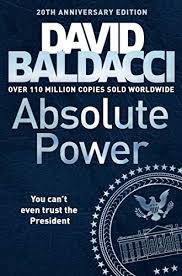
Book review – ‘Absolute Power’ by David Baldacci

“…the business of politics, which essentially meant screwing others before they got around to screwing you.” 

For a recent holiday I wanted a good thriller book to read. After reading lots of non-fiction business books and lots of philosophical novels recently, I wanted something that wasn’t quite as intellectually challenging. Something that was more plot than unanswered questions.

I settled on Absolute Power because the reviews were really positive, and I’ve heard the Clint Eastwood film is fairly good.

In terms of plot Absolute Power is very outrageous to say the least. An elderly burglar, looking for one last job, breaks into the house of a prominent businessman while he’s out of the country. Everything is going well until the businessman’s wife turns up…with her lover and his entourage.

The thief manages to hide and, within minutes, is forced to watch the woman’s final moments as she’s murdered. Shocking, to say the least. But the only thing more shocking is the man involved in her murder…the president of the United States.

“Arrogant people habitually overestimated their own abilities and underestimated everyone else’s.”

This tense and violent opening chapter sets the scene for a tale full of conspiracies, tragedies and surprises.

It also contains sub-plots. A lot of them. From my description of the plot, you might think that the thief is the main character. But he’s not, in fact he has very little actual dialogue throughout the novel – which is something of a shame as, despite his flaws, he’s one of the more likeable characters.

That’s perhaps one of the main issues with Absolute Power. There’s a very large cast of characters. Too many. All with their own sub-plots and backstories. Baladacci does a great job of developing them, but he gives them all so much time that, after a while, I was left wondering who the actual protagonist was. My favourite being the smalltown detective who ended up investigating the murder and getting well and truly out of his depth.

“He should have known that nature bowed to no one, regardless of their monetary worth.”

Eventually Jack, a young hotshot lawyer, becomes the main ‘good guy’ – but, even then, he spends most of the book trying to cheat on his fiancee while still trying to keep her sweet as her dad is a big shot client of his. Not exactly a great guy…but flawed protagonists are more realistic, right?

I described ‘Absolute Power’ as a thriller in the start of this review. But, to be honest, it’s a real mix of genres – thriller is just the easiest way to categorise it. It also has elements of courtroom drama, police procedural, political commentary, action, spy thriller and conspiracy theory.

Absolute Power starts off really well and keeps its pace for the first quarter – however, the amount of sub plots and characters do slow it down halfway. But it’s worth persevering through as the last quarter is really engaging and gripping stuff.

“You know what kind of person it takes to run for President? Not normal. They could start out okay, but by the time they reach that level they’ve sold their soul to the devil so many times and stomped the guts out of enough people that they are definitely not like you and me, not even close.”

While the plot is very imaginative, there’s also a sense of realism to it. I genuienly found myself thinking that…if such a cover-up ever did happen…this is probably what would happen.

I’ll give this a 4/5 for sheer entertainment value. It’s not going to change your life but sometimes that’s not what you want from a book. I don’t think I’ll ever read it again and, five years from now, it won’t be in my thoughts but for the time that I shared with it I enjoyed it.


How old Tom & Jerry cartoons can help you tell your brand’s story

When you were younger, did you ever watch the old ‘Tom & Jerry’ cartoons?

Or, any of those other old school cartoons from that time period?

If so, you may remember an old gag they used to do.

Usually it involved a newly born baby duckling (or baby bird in general) who would mistake one of the characters (usually Tom) for its mother.

It would then follow him round for the majority of the episode.

This harks back to a phenomenon that animal experts call ‘imprinting’. So, when a baby duck is born it usually sees its mother right away and then never forgets her.

However if the duck sees someone or something else first it can often think of it as its mother.

When it comes to branding, if you’re to tell your story and make it stick in your potential customers’ minds it’s worth thinking about your unique selling points.

Is your business a world first? Do you do something that’s never been done before?

How can you imprint yourself in someone’s mind to make sure you’re the first thing they think of?

Think coke…which brand do you think of? Think fast food burgers…who comes up? Think low cost airline…who do you think of?

And so on.

Your answers to these questions could be marginally different to mine…but I bet that we’re very close.

Telling stories is all about being unique and, when you can be, being a world first.

By Ashley Brown

This article was inspired by “Positioning” by Al Ries and Jack Trout

Genghis Khan on creative leadership….

There are thousands upon thousands of articles out there on leadership. All full of ‘important’ yet often conflicting information.

But one thing that most of them agree on is that, to make it in business, you need have a ruthless streak.

There are leaders like Steve Jobs and Richard Branson.

And then there are leaders like Genghis Khan. If you’ve not heard of him, then you must have skipped history at school.

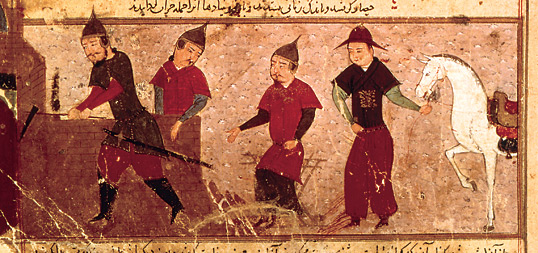
He lived from 1162 to 1227 (which was old for those times) and is most notably known for being the founder of the Mongol empire. He was a ferocious, fearless leader who wasn’t afraid to massacre whole tribes to get where he wanted.

genghis

Sure, not exactly a nice guy…but damned successful at getting what he wanted.

As an aside – I always find it interesting that, even though he’s one of the biggest historical figures ever, there’s no official record of what he looked like. Some reports say he was tall and thin, some say short and stout…while others claim that he was (unusually for the Mongol empire) a ginger chap.

But, as ruthless as he was, Genghis Khan had an eye for talent. Which is something any leader…creative or otherwise…should have. And, he was reasonable enough to put this eye for talent ahead of his own personal feelings.

Let me tell you a story that highlights this well…

It was 1201 and Genghis was embroiled in a battle with the nearby Taijut tribe. It was a bloody, nasty business and he was lucky to win.

As the best leaders do Genghis led by example and rode into battle along with his troops and lieutenants.

He was a skilled warrior, but in this particular battle he nearly fucked up.

An arrow slammed into his horse and he was thrown off, he hit the ground and narrowly missed being slayed by the Taijut.

As Genghis Khan’s fortune would have it the Mongol tribe won.

Genghis_Khan_and_three_of_his_four_sons

He was furious that he’d come so close to death, and afterwards he addressed the Taijut prisoners and asked them who it was who fired the offending the arrow. Of course, as he did so, he didn’t expect for a minute that the culprit would come forward.

But he did.

A Taijut archer stepped forward and claimed responsibility.

Khan’s initial reaction was to kill the man where he stood. But then, he thought better of it. It was an incredible shot to hit his horse from such a distance…the archer must have been talented.

So, stirred by the archer’s boldness and in awe of his talent, Genghis Khan offered him a job.

He went on to become one of the Mongol’s most esteemed field commanders.

So there we have it. A lesson from history. Don’t let personal feelings get in the way of admiring and recruiting talent. Just because someone doesn’t agree with you at first, doesn’t mean that you can’t reach them eventually.

…don’t you just love loose metaphors?

As a side-note, Genghis Khan created one of the world’s first ever postal systems – so he was definitely more than just a barbarian!

The coffee cup that reminded me I was human

So, there I am. It’s a little after 9am and I’m on an aeroplane.

I’ve been up since 4am and my brain has become a bubbling hybrid of two extremes. Sleepiness and pre-holiday excitement.

When it comes to travel I’m a reader. I love to read when I’m on a flight or a long drive. It’s guilt-free reading time when you have nothing else to do but lose yourself in words that inspire and interest you.

So, to keep myself sharp, I order a coffee. This turns up:

wp-image-103165078

I assumed that the bit on the top was to allow the coffee to cool down. I left it for a while and came back to it…only to find out that it was too hot.

So I pull the lid off, let it cool down, and then take a sip. Damned if I don’t get a mouthful of coffee suds.

Instantly my stunned mind went to blame the airline. Why on earth would they serve coffee with such sediment?

The flight attendant walks past, smiles at me, notices that I put my lid on the floor and asks me if I want another one.

Why? Why would I? I just took the lid off…


And then it hits me. The ‘cooling off bit on the top’ (great phrasing) is actually a filter…to stop idiots like me getting a mouthful of coffee suds.

And so I gratefully accepted the new lid and enjoyed my coffee through the filter.

For a moment or two I felt the thing that we all fear most…idiocy.

It was so obvious…how did I not realise?

Hindsight has a way of making you feel ridiculous, doesn’t it?

But that feeling didn’t last long. Pretty soon it disappeared into the clouds around me and slipped away from everyone else’s memory.

I mean, after all, in a world where we try our hardest to know everything and to uncover every secret…it’s nice to sometimes realise just how stupid you are.