Great storytelling starts in the street.

I studied journalism at university. It was interesting.

After four years I graduated with a broken ankle, upper second class honours and a handful of social skills.

While there I went to a talk by the journalist and documentary maker, John Pilger.
(check out his site or his books if you’ve not heard of him before)

He said a lot of great stuff.
But, this was the line that has always stuck with me:

“Great journalism starts in the street”.

He’s right, you know.

But let me edit that quote to something more relevant to us:

“Great storytelling starts in the street”.

After all, writing is storytelling.

Writing your C.V? You’re telling the story of your career.
Writing an advert, or copy for a site? You’re telling the story of your product.
Writing a speech? You’re telling the story of why others should think a certain way, or do a certain thing.

It’s all kinda obvious really, isn’t it? But, sometimes I think someone needs to point out the obvious, because it’s so easy to discard or forget.

I guess that someone is me.

Next time you’re out take in your surroundings. Listen to the people around you.

Soak everything up and look for inspiration.

9 times out of 10 you’ll find that the audience you’re writing for will be made up of normal, everyday people.

Where will you find them? In the street, of course.

The more in touch you are with what every day people do and how they react, the easier it’ll be able to change your style to one they’ll connect with.

I once had to write an article about coffee tables.
I know nothing about them.
So, I spent an hour in House of Fraser – hovering around the furniture section, listening to families as they discussed their purchases.

I learnt the things people look for, and the things that put them off.

Do I need to get a life? Probably.

Did I learn a lot? Yes.

So there you have it, you can be inspired and you can learn from the world around you.

Great ideas start in the street.
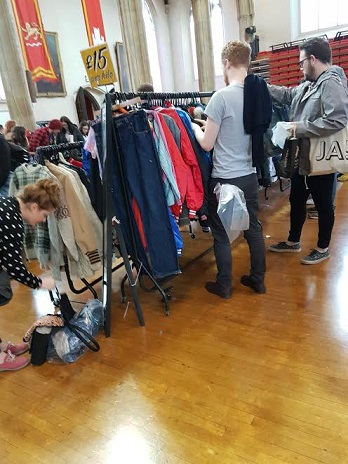
9 reasons why vintage fairs give creatives hope…as well as slightly musty clothes.


Today I didn’t write because I went to a vintage fair.

You know the ones I mean? Where a lorry full of veteran garments and  lovable rogues turns up at your local city hall – determined to separate you from your hard-earned monies.

This one in particular was a ‘weigh & pay’ – basically you’re given a rather unglamorous cellophane bag and you fill it with clothes. A kilo costs £15.

There’s a good sales angle with this – you get to a kilo way faster than you’d suspect, and the prices only inflate from there.

A lot of the track-tops for sale took me back to my P.E days. If only I’d have been an entrepreneur at school – on my last day I could have tip-toed into the ‘lost property’ cupboard and pillaged their stocks.

Let them sit for another ten years or so I’d have a fortune on my hands!

Let’s face it, we’d all like to make our mark on the world by creating something truly original – but, it’s hard to do that.

I mean, everything has been done before hasn’t it?

But, as creators, vintage fairs should give us hope.

These clothes, which were new once – and which were also old and out of fashion once, have a new lease of life and a new market to be sold to.

Vintage fairs are busy, busy, busy and money certainly exchanges hands.

The organisers have found a new way to sell something old. And, as creatives, this is how we should look at things.

Reinvent, re-imagine, retell.

You remember that writer from years and years ago – Mark Twain? He said the following, and I think we all need to keep this in mind:

“There is no such thing as a new idea. It is impossible. We simply take a lot of old ideas and put them into a sort of mental kaleidoscope. We give them a turn and they make new and curious combinations. We keep on turning and making new combinations indefinitely; but they are the same old pieces of coloured glass that have been in use through all the ages.”

Take the movie “28 Days Later”. We’d all seen zombies before that. Those shuffling, decaying old things moving towards their prey with all the panache of a salt-ridden slug!

But then “28 Days Later” came along and we were introduced to fast-moving, rage-fuelled zombies.

These were something else! You couldn’t outrun them and you could barely outfight them. They’d smash your windows with all the force of a hurricane and they were smart-enough to find you afterwards. A locked bedroom door gave you little safety.

Thus audiences were interested again in a genre which hadn’t seen much originality since the 1960s/1970s when George A. Romero launched his “of the dead’ series.

It’s the same with business too. Look at Facebook – it wasn’t the first social media, was it? I can sure as hell remember using Myspace and bebo (for my sins) before that. Even one called ‘Facebox’, anyone give that a whirl back in the day?

Yet Facebook stood tall over them all. It captured our imaginations at a time when our lives were first saturated with the power of social media, and kept us in its thrall long after the competition had fallen in cyberhell.

Sure, it may not be as popular as it was once – but how often do you go a day without hearing the word ‘Facebook’ or ‘Facey B’ – depending on your social cricle.

I can recall a time when I’d use ‘Altavista’ or ‘Ask Jeeves’ as my preferred search engine of choice.

Fast forward ten years and I’m writing this blog post on ‘Google Chrome’ – can you remember the last time you used another search engine?

I can’t.

These ideas weren’t original, but that didn’t mean that they lacked the imagination and the drive to get to the top of the table.

Reinvent, re-imagine, retell.

100 ways to win an argument with yourself…

How many times a week do you argue with yourself?

By that I don’t mean to ask how often you sit in the corner of the pub and talk about politics to yourself. And, come on – who needs to spend time doing that when the internet has a pulsing community full of people waiting to argue over opinions and theories?

What I mean is…how often have tried to convince yourself to do something? To exercise, to get up earlier…or to write?

How often have you sat in front of your computer – ready to unleash your creative genius onto an empty Word document? Only to find that your games console was more appealing, or perhaps the lure of daytime TV was too much?

Is a day to yourself even a day to yourself without catching the Frasier double bill before ‘enjoying’ an episode of Jeremy Kyle?

As with many blogs today this one is, again, about motivation and how you need to fight that inner voice of distraction. After all the people you see as successful, they didn’t get there through not being bothered.

You know what quote I really like?

“A journey of a thousand miles begins with a single step”
– Laozi, Chinese philosopher (circa 600 BCE)

You’ve probably seen this on hundreds of t-shirts, mugs and posters. Quite rightly too. It is motivational and it is inspiring.

But what Laozi was really saying, to me, is that most people can’t be bothered, most people are inactive when it comes to following their dreams. So, the brave soul who makes that first metaphorical step may well be the one who gets to where they want to be.

I use this quote not to inspire me, but to remind me that there are loads of people around me who can’t be bothered.

For as long as they stay that way, there’s less competition for me.

Next time you have that argument with yourself, where the voice of laziness or procrastination tries to steer you away from your goals – think about our friend Laozi.

Not just his quote which has been demeaned by cheap coffee cups – but the fact that so many others won’t make that step…meaning that you’ll already be standing out if you do.

Will you remember the day you lost yourself to daytime TV or the day you kept your focus and started the ‘thing’ that cemented your dreams for you?

6 tips on how to write good English from the bloke who did ‘1984’…

You can write, right? You can construct a sentence, hold your audience and get your point across? Or at least you like to think so? Even the best of us can improve though, you should take a look at this…

As you may have seen, the novel ‘1984’ has had something of a second birth recently – due to a mixture of the current political climate and the simple fact that true classics never die. Like fashion, classic books tend to be reinvented by shifts in culture.

It’s been sitting in bestseller lists since it was first published in 1949. I vividly remember the first time I read it, some thirteen years ago.

I’m not sure if you were aware, but Orwell actually came up with a few succinct rules that anyone who wants to write English (well) should follow. I thought I’d share them with you on this Tuesday Evening, and I’ll add my own two bits underneath each one.

– Never use a metaphor, simile or other figure of speech which you are used to seeing in print.

Be original and don’t sound like every other soul out there. This is especially relevant now, as with the internet everyone has a voice and a platform to broadcast it from. Any two-bit writer (ahem) can start up their own blog with a silly name and starting typing! To stand out, the majority of your words need to be cliche free.

– Never use a long word where a short one will do.

Long words may go down well with an academic audience, but not every audience member is going to have a MENSA membership. Big words tend to break sentences up and if a reader snags too much while looking at your piece their minds and their eyes will soon wander…and you don’t want them to go off and buy ‘The Sun’, do you?

– If it is possible to cut a word out, always cut it out.

Less is more. With every sentence you write you’re fighting to keep your reader, so don’t drone. Be your own editor too – look everything over, and don’t be afraid to cut bland words out. You’ll also be surprised at how many typos you make when you look back at what you’ve done.

This isn’t your ‘6000 word’ University essay – you don’t need to ‘pad it out’.
(Ignore this if you’re still a student – pad away!)

– Never use a passive where you can use the active.

Active makes for exciting writing. Who gets off on reading boring stuff?
Active: The dog bit the man.
Passive: The man was bitten by the dog.
See this example here? Admittedly it’s not the longest sentence either way, but the former grabs you right away – it’s snappy (pun!) and to the point, and you’re instantly waiting for the next sentence. Whereas the latter feels a bit slow, and you have to almost compute it before you read the next sentence.

– Never use a foreign phrase, a scientific word or a jargon word if you can think of an everyday English equivalent.

Goes hand in hand with your audience – by all means use exciting words and turns of phrase – but if everyone was well-versed in jargon they wouldn’t call it jargon. Think of the internal frame of the business you work for – would your average joe (or reader) know all of your office slang and corporate terms?

Err…wot’s ROI?

– Break any of those rules sooner than say anything barbarous.

I Googled what barbarous meant. It means brutal. I guessed that because it sounded like ‘barbarian’ and barbarians aren’t known for being gentle, especially Conan.

Come on – you were wondering why I had a pic of Arnie instead of Orwell, right?

If you’re interested in Orwell’s essay, ‘Politics and the English Language’ check it out here.

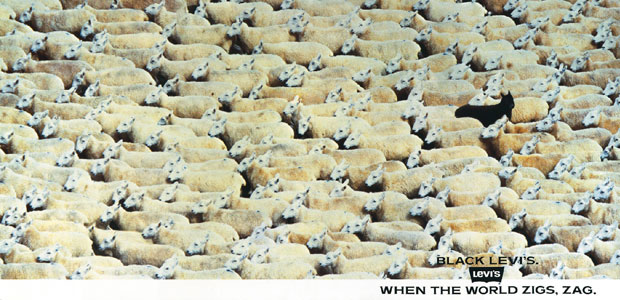
When the world zigs, zag.

It’s a Saturday morning, and I thought I’d kick off the day by sharing this image. It’s one that I always go back to, in a effort to remind myself that sometimes the greatest ideas are the simplest.

It was 1982 and everyone was wearing blue jeans, as they had been for many years. Levi Strauss was considered the market leader and zillions of people all over the globe would visit their stores to get their jeans.

However, there were rumours that denim was going out of fashion and so Levi’s wanted to play a daring ace card…they wanted to launch black denim. Something pretty alien to their customers at the time.

They approached advertising agency BBH and thus the poster above was born, and it was a rip-roaring success.

Many fashionistas like to go against the grain, and be different from ‘sheep’ the world over so the image of the black sheep going against the tide appealed to them.

Not only that, but the clothes we wear are a form of expressionism and we all like to think we’re an individual – just like the black sheep in that picture.

Looking at this also makes me want to go out and buy Levi’s jeans…why must I be such an easy target for advertising bigwigs the world over?

Minimalism and the never-ending ‘how are you?’

So, you’ve got a day to yourself and you’ve got a little bit of money in your back pocket. You decide to go shopping and pick up some new clothes, because let’s face it – even the best stocked wardrobe needs to be freshened up every now and then.

You walk into one of those kind of sleek clothes shops that have more mannequins than clothing lines – you know the type I mean, right? The sort of uber-white, brightly lit joint that’s so minimally minimalist you almost think you’ve accidentally walked into an empty lot.

As you enter a sales assistant walks past you – stopping briefly to assess you. They work out your social stature, your waist size and whether or not you fit in with their pre-programmed ideals of what looks best for the brand.

“Hi, how are you?” they sing out cheerfully, a couple of coat-hangers strung over each shoulder – the attached garments billowing out in their wake like a cape. A superhero for the well dressed minimalist capitalist consumer.

So, what do you say? I mean you’re not going to open up your deepest, darkest fears to a stranger are you? Well, you might. But most likely you’ll just say “I’m good” and then go about your day…staying perhaps a couple more minutes before you decide that a white t-shirt with a full stop in the middle isn’t going to make you look as cool as the person you want to be.

But do you know what I always say?

I always say, “I’m good thank you, how are you?”

And do you know what they say? Nothing. They’ve already walked past and gone back to their day – forever leaving me hanging.

Not just clothing shops, but all sorts of stores, restaurants and even bars. I’m always left wondering how they are and how their day is going.

Why do I ask? Why do I care?

Because I feel that, as a writer, I need to be in tune with other people…I need to be interested in other people.

Because that’s where the true stories lie – the beauty of observation is that it’s so easy! There are great characters all around us, with great perspectives and feelings – but if we don’t take any notice of them, we’re losing free research. A free chance to craft and calculate new characters.

It’s a well-known fact that many authors base characters on people they’ve known – because the best characters tend to originally be born of flesh and blood – not from the factories of the creative mind. Or, at least not fully.

So, open your eyes/ears and ask someone how they are.

Centre Circles & Corner Kicks

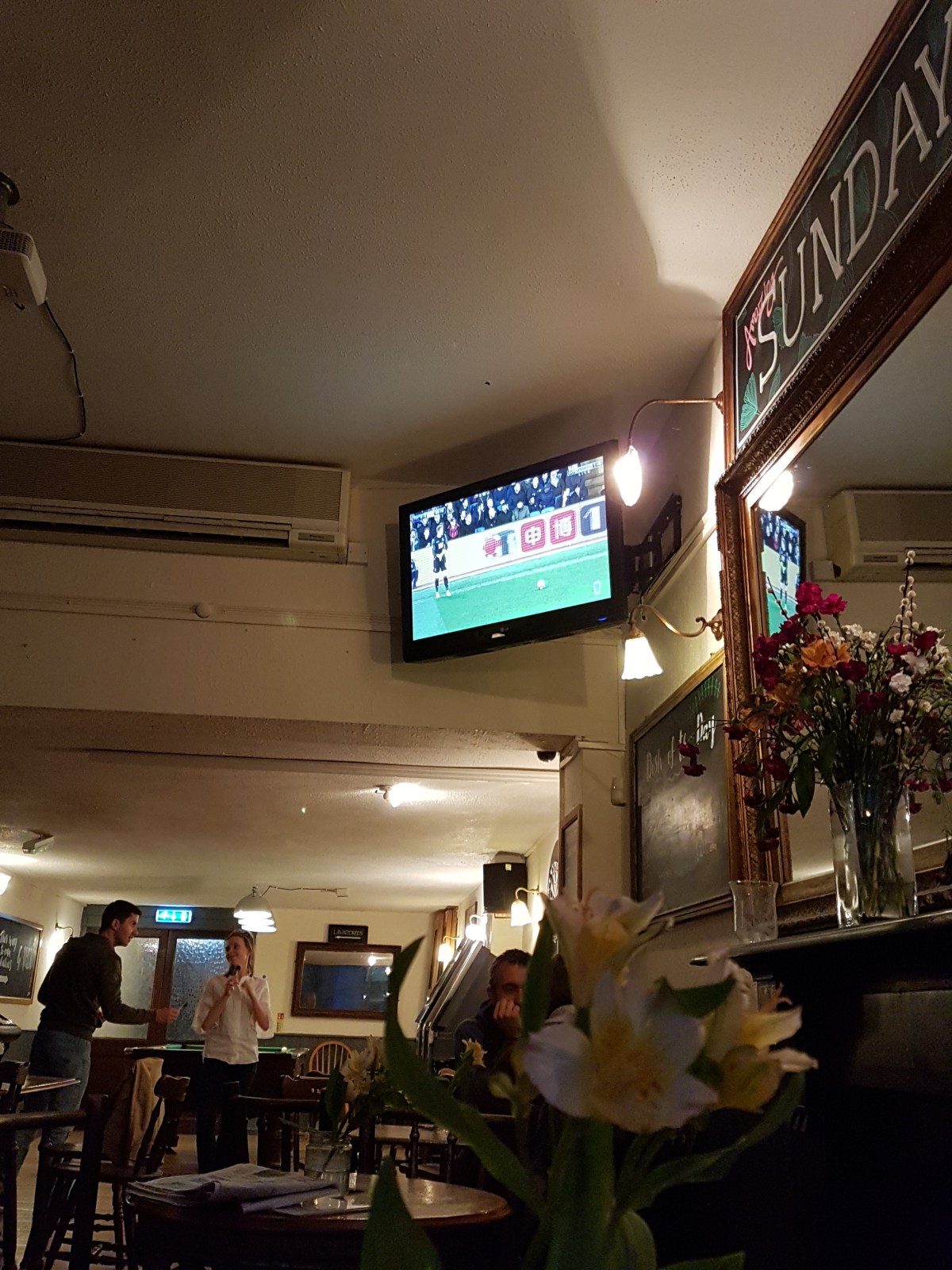
I didn’t write this evening because I watched the football.

Creatives aren’t just the artists and the writers of this fair lonely planet. They can be in all walks of life from engineers to footballers.

Ever since the days of gladiators and colloseums sport has always united and divided us.

Long may it continue. 

I’ll write tomorrow. Tomorrow is the day where I’ll begin walking down the path to becoming the greatest writer who ever lived..