Sports, marketing & moolah: is everyone a winner?


At around 9PM yesterday evening the eyes of the world were fixed on the glitzy smorgasbord of sin that is Las Vegas.

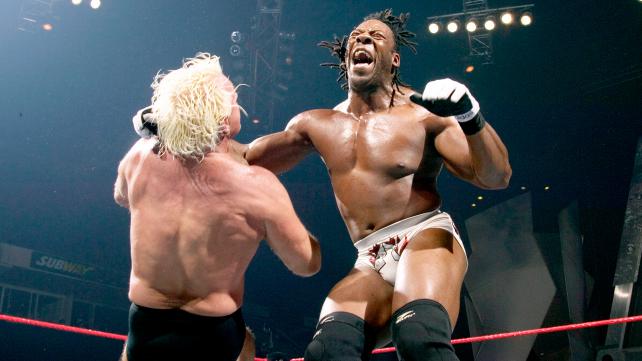
In perhaps the most hyped up boxing match of our lives Floyd Mayweather took on Conor McGregor.

The media had been building it up for weeks and weeks. Both fighters were very high profile and very outspoken – meaning that there was constant content to be harvested. A sports editor’s dream.

Boxing has always been full of big characters and drama – it relies on promotion, so mountains are made out of molehills as much as possible.

But there was something unique about the fight.

Floyd Mayweather has been called the best boxer of his generation, and as he has now retired with 50 wins and no losses, you could argue that that’s fair comment.

However his opponent, Conor McGregor, wasn’t an actual boxer. He’d never competitively fought in a boxing ring – yet he’d called out Mayweather, and Mayweather had answered.

Crazy isn’t it? Most people would go out of their way to avoid clashing with an unbeaten professional boxer.

But, not McGregor.

He was a professional MMA fighter, which is very different to boxing.

But, there he was!

Calling Mayweather out and telling anyone who would listen that he’d beat him.

The media lapped it up. Crazy headlines all round. Some even told us that medical experts had warned McGregor, telling him not to compete for the sake of his health.

None of it stopped him.

He managed to last ten rounds but eventually Mayweather clinched it. Much to the relief of the bookies.

Both men survived and then went their separate ways. McGregor back to his native Ireland, and Mayweather to enjoy his retirement.

McGregor lost. Technically. But he also pocketed $30 million for the fight (with Mayweather taking away $100).

cash

Previously the most McGregor had ever won was $3 million. Now he can times that by ten. So, really, neither man lost. Or at least not in a coventional sense.

I mean, would you feel defeated if you received 30 million dollars after a really bad day at the office?

Is money in sport (and other big industries) changing the meaning of the word loss?

Sure, McGregor maybe disappointed that he didn’t win (that is if he ACTUALLY believed he would), but just imagine what he can do with that 30 million.

Mayweather said after the fight: “If I see an opportunity to make $300m in 36 minutes, why not? I had to do it.”

That says it all, it was a fight made from marketing more than anything else. Yet people bought into it, they paid to see it and they betted on it. All of them clinging on to the slight hope that this underdog might just prevail.

Back in the day I used to captain a six-a-side football team in a Sunday league. Each week we paid a few quid to play. On many of those weeks we lost.

It built character and comradeship between us, and each week we’d come back with a new determination.

I wonder if we’d have been quite so bothered by a loss if we received a big cash injection afterwards. As we were students back then, I highly doubt it…

Take professional footballers for example, imagine if they were only paid for the games they won – how different do you think things would be?
 

Beyond the headlines…

Here’s a fact for you….

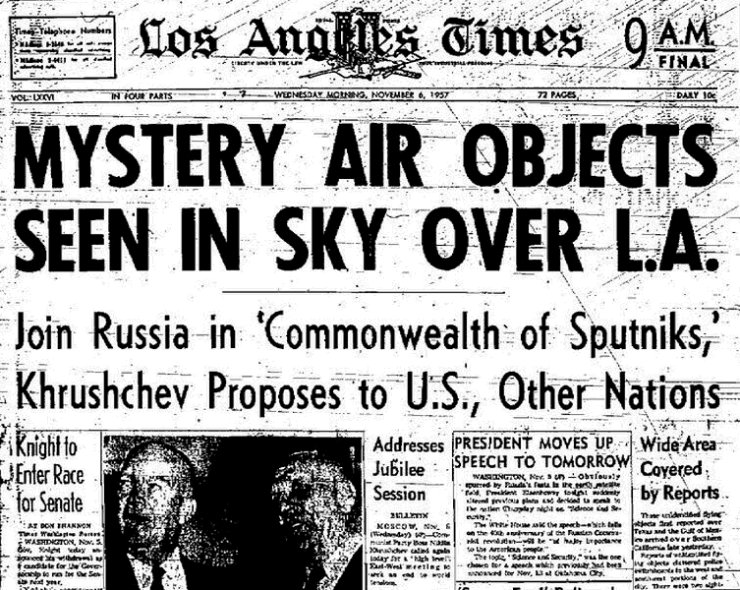
“On average, 8 out of 10 people will read headline copy, but only 2 out of 10 will read the rest.”
(Courtesy of Copyblogger)

It’s interesting, isn’t it?

And, almost sad in a way – because I know that many writers put so much effort into their actual content.

Headlines can be frustrating too. After all, they’re always limited and you can only get across a fraction of what you want to say.

So, I guess that’s the trick.

Finding that biting point – the right amount of information, to go along with the right amount of ‘readme’ promiscuity.

Find a hook, reel them in and then concentrate on engaging the few people who actually continue reading.

And remember, once you’ve got that headline out of the way – ever other line that you write is in itself an argument to get your reader to read the next line.

And the next. And the next. And the next.

Make every word count!


Wanted: Solar-powered clothes dryer

For as long as we humans have walked the Earth, many of us have been honest.

Many of us have wanted to work hard, help others and then reap the rewards for our labour.

However, there are also those of us who look to to scam and deceive everyone around us!

These scam artists often tend to be very creative…I guess not all of us creatives can be good, can we?

Let me take you back the sixties and seventies. The war was well over, the baby boomers were here and people had a quality of life that would have seemed alien to them some years before.

Gadgets were all the rage (as they are now).

Solar-power was one of the buzzwords of the time and everyone wanted to use it whenever they could.

Why not help out the planet as and when you can?

A man called Steve Comisar was out to make some money.

Print advertising was big back then.

So he put an advert in the magazines and papers selling this amazing new gadget:

“Solar-powered clothes dryer – just $39. The planet friendly way to dry your clothes – never use your tumble-dryer again. Send the money and I’ll have one sent out to you within a week, free delivery – life-time guarantee!”

Believe me when I say that people bought into the idea. Families rushed to send over their hard-earned dollars.

And then they waited. Curiously. Sitting there, in their homes, imagining how this new, wacky invention might look.

You can imagine their surprise when it arrived. It looked just like this:

MEN-JJ09-clothesline1

Yep, just your average, run-of-the-mill clothesline. One that you can find in nearly every garden in the country.

As you can imagine people were pissed, and Steve Comisar is still doing time now for that and a combination of other scams.
(I believe that the only U.S. con artist bigger than him was Frank Abingale – he was the guy the film ‘Catch Me If You Can’ was based on.)

Of course I’m not saying that we should go around scamming people, and I’m not advocating a crook.

But – there’s creativity here.

Comisar looked at the current market, saw a theme that everyone was interested in (solar power) and then found a new way to market something around it.

Why don’t we embrace creativity like this and use it to market and sell genuine products?

Or perhaps, if we’re writing fiction – we can take a standard plot, and re-imagine it in such a way that it gets a new lease of life?

The last man on Earth sat alone in a room…

“The last man on Earth sat alone in a room. There was a knock on the door.”

How’s that for a first line? (Or maybe two lines, as there’s a full stop in-between).

It conjures up a lot of questions and it had me, for one, wanting to read on.
Who is this man?
What happened to everyone else?
Is he the last man on the earth, or the last actual person?
Etc.

When it comes to writing anything that you want someone to read it’s important to hook them in, from either the headline or the first line. It seems kind of obvious, doesn’t it?

But then, you’d be surprised how few people actually put it into practice.

‘On average, 8 out of 10 people will read headline copy, but only 2 out of 10 will read the rest.’ (Copyblogger)

Ask a question, inspire thought – do something that will make the reader want to continue.

Because, once you’ve written than opening line, every other word you write is, in itself, a reason to get your audience to read the next word.

If you’re interested in where that quote came from at the start, it’s been taken from the short story ‘Knock’ – written by Fredric Brown.

It was based on the following short segment of text, which was written by Thomas Bailey Aldrich:

“Imagine all human beings swept off the face of the earth, excepting one man. Imagine this man in some vast city, Tripoli or Paris. Imagine him on the third or fourth day of his solitude sitting in a house and hearing a ring at the door-bell!

Class dismissed.

Aperol Spritz 

Apologies for being quiet over the last few days. Work took me out of the picture and away – which meant that I didn’t write.

I debated bringing a laptop, but as is the way if you bring a book somewhere, You spend half your time answering questions about what you’re doing (or ‘what you reading?’)

While out, I came across this advert and had to take a wonky (beer-induced) picture.

The simplicity and the colours really work on this.

And, as Aperol is such a popular name, they don’t even worry about putting anything complicated in the copy.

Simple. On point. Whets the appetite.

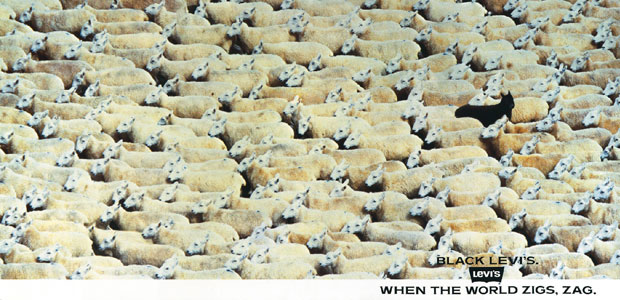
When the world zigs, zag.

It’s a Saturday morning, and I thought I’d kick off the day by sharing this image. It’s one that I always go back to, in a effort to remind myself that sometimes the greatest ideas are the simplest.

It was 1982 and everyone was wearing blue jeans, as they had been for many years. Levi Strauss was considered the market leader and zillions of people all over the globe would visit their stores to get their jeans.

However, there were rumours that denim was going out of fashion and so Levi’s wanted to play a daring ace card…they wanted to launch black denim. Something pretty alien to their customers at the time.

They approached advertising agency BBH and thus the poster above was born, and it was a rip-roaring success.

Many fashionistas like to go against the grain, and be different from ‘sheep’ the world over so the image of the black sheep going against the tide appealed to them.

Not only that, but the clothes we wear are a form of expressionism and we all like to think we’re an individual – just like the black sheep in that picture.

Looking at this also makes me want to go out and buy Levi’s jeans…why must I be such an easy target for advertising bigwigs the world over?